
MRP: ₹16465
₹12545
₹ 3920 Off
(Incl. of all taxes)
Qty
Buying in bulk?
In stock
Deliver to
- 7-day returns
- Secure payment
- International shipping
- Carefully packed
Get this at ₹ 11918Extra 5% OffAdd items worth ₹999 to the cart & get extra 5% off
Get this at ₹ 11291Extra 10% OffAdd items worth ₹1499 to the cart & get extra 10% off
Book Summary
Evolutionary algorithms are successful biologically inspired meta-heuristics.
Their success depends on adequate parameter settings. The question arises: how
can evolutionary algorithms learn parameters automatically during the
optimization? Evolution strategies gave an answer decades ago: self-adaptation.
Their self-adaptive mutation control turned out to be exceptionally successful.
But nevertheless self-adaptation has not achieved the attention it deserves.
This book introduces various types of self-adaptive parameters for evolutionary
computation. Biased mutation for evolution strategies is useful for constrained
search spaces. Self-adaptive inversion mutation accelerates the search on
combinatorial TSP-like problems. After the analysis of self-adaptive crossover
operators the book concentrates on premature convergence of self-adaptive
mutation control at the constraint boundary. Besides extensive
- ISBN-13
- 9783540692805
- Language
- English
- Binding
- Hard Bound
- Publisher
- Springer
- Publishing Date
- 2008-10-01
Self-Adaptive Heuristics For Evolutionary Computation (Studies In Computational Intelligence)
Frequently bought together
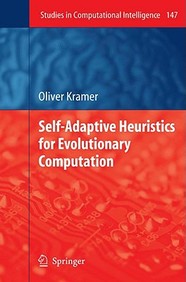 Self-Adaptive Heuristics For Evolutionary Computation (Studies In Computational Intelligence)₹12545This item
 Maarikaadu₹63
 Natyamayuri₹63
Total for 3 items₹12671₹16605You save ₹3934
Product Specifications
Book Summary
Evolutionary algorithms are successful biologically inspired meta-heuristics.
Their success depends on adequate parameter settings. The question arises: how
can evolutionary algorithms learn parameters automatically during the
optimization? Evolution strategies gave an answer decades ago: self-adaptation.
Their self-adaptive mutation control turned out to be exceptionally successful.
But nevertheless self-adaptation has not achieved the attention it deserves.
This book introduces various types of self-adaptive parameters for evolutionary
computation. Biased mutation for evolution strategies is useful for constrained
search spaces. Self-adaptive inversion mutation accelerates the search on
combinatorial TSP-like problems. After the analysis of self-adaptive crossover
operators the book concentrates on premature convergence of self-adaptive
mutation control at the constraint boundary. Besides extensive
Book Specifications
- ISBN-13
- 9783540692805
- Language
- English
- Binding
- Hard Bound
- Publisher
- Springer
- Publishing Date
- 2008-10-01