
MRP: ₹9614
₹7996
₹ 1618 Off
(Incl. of all taxes)
Qty
Buying in bulk?
In stock
Deliver to
- 7-day returns
- Secure payment
- International shipping
- Carefully packed
Get this at ₹ 7596Extra 5% OffAdd items worth ₹999 to the cart & get extra 5% off
Get this at ₹ 7196Extra 10% OffAdd items worth ₹1499 to the cart & get extra 10% off
Book Summary
Solutions to most real-world optimization problems involve a trade-off between
multiple conflicting and non-commensurate objectives. Some of the most
challenging ones are area-delay trade-off in VLSI synthesis and design space
exploration, time-space trade-off in computation, and multi-strategy games.
Conventional search techniques are not equipped to handle the partial order
state spaces of multiobjective problems since they inherently assume a single
scalar objective function. Multiobjective heuristic search techniques have been
developed to specifically address multicriteria combinatorial optimization
problems. This text describes the multiobjective search model and develops the
theoretical foundations of the subject, including complexity results. The
fundamental algorithms for three major problem formulation schemes, namely
state-space formulations, problem-reduction formulations, and
- ISBN-13
- 9783528057084
- Language
- English
- Binding
- Paper Back
- Publisher
- Vieweg+Teubner Verlag
- Publishing Date
- 1999-06-29
Multiobjective Heuristic Search: An Introduction To Intelligent Search Methods For Multicriteria Optimization (Computational Int
by P.P. Chakrabarti, Pallab Dasgupta (Author),
Vieweg+Teubner Verlag (Publisher)
fictionfantasyyoung adultaward winning
Frequently bought together
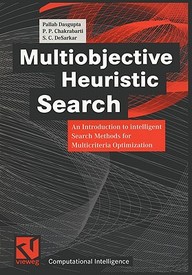 Multiobjective Heuristic Search: An Introduction To Intelligent Search Methods For Multicriteria Optimization (Computational Int₹7996This item
 Maarikaadu₹63
 Natyamayuri₹63
Total for 3 items₹8122₹9754You save ₹1632
Product Specifications
Book Summary
Solutions to most real-world optimization problems involve a trade-off between
multiple conflicting and non-commensurate objectives. Some of the most
challenging ones are area-delay trade-off in VLSI synthesis and design space
exploration, time-space trade-off in computation, and multi-strategy games.
Conventional search techniques are not equipped to handle the partial order
state spaces of multiobjective problems since they inherently assume a single
scalar objective function. Multiobjective heuristic search techniques have been
developed to specifically address multicriteria combinatorial optimization
problems. This text describes the multiobjective search model and develops the
theoretical foundations of the subject, including complexity results. The
fundamental algorithms for three major problem formulation schemes, namely
state-space formulations, problem-reduction formulations, and
Book Specifications
- ISBN-13
- 9783528057084
- Language
- English
- Binding
- Paper Back
- Publisher
- Vieweg+Teubner Verlag
- Publishing Date
- 1999-06-29