
MRP: ₹4007
₹3104
₹ 903 Off
(Incl. of all taxes)
Qty
Buying in bulk?
In stock Only 5 left
Deliver to
- 7-day returns
- Secure payment
- International shipping
- Carefully packed
Get this at ₹ 2949Extra 5% OffAdd items worth ₹999 to the cart & get extra 5% off
Get this at ₹ 2794Extra 10% OffAdd items worth ₹1499 to the cart & get extra 10% off
Book Summary
This book synthesizes and extends modern political-economic theory to explain
the postwar evolution of macroeconomic policy in developed democracies. Chapters
II-IV study transfers, debt, and monetary/wage policy-making and outcomes,
stressing that participation enhances transfer-policy responsiveness to
inequality and vice versa, that policy-making veto actors retard fiscal-policy
adjustments, inducing greater long-run debt-responses to all other
political-economic stimuli, and that monetary policy's nominal and real effects
depend, respectively, on the broader political-economic interest-structure and
on wage-price bargainers' sectorial composition and coordination. Broadly, the
book argues that these developments have exacerbated the distributional
conflicts inherent in the policies to which postwar governments had committed
while undermining their more-universally desired efficiency-fostering roles.
Battles that once
- ISBN-13
- 9780521004411
- Language
- English
- Binding
- Paper Back
- Publisher
- Cambridge University Press
- Publishing Date
- 2002-02-28
- Product Edition
- illustrated edition
- Total Pages
- 332
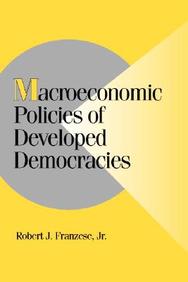
Macroeconomic Policies Of Developed Democracies
Frequently bought together


Total for 3 items₹3230₹4147You save ₹917
Product Specifications
Book Summary
This book synthesizes and extends modern political-economic theory to explain
the postwar evolution of macroeconomic policy in developed democracies. Chapters
II-IV study transfers, debt, and monetary/wage policy-making and outcomes,
stressing that participation enhances transfer-policy responsiveness to
inequality and vice versa, that policy-making veto actors retard fiscal-policy
adjustments, inducing greater long-run debt-responses to all other
political-economic stimuli, and that monetary policy's nominal and real effects
depend, respectively, on the broader political-economic interest-structure and
on wage-price bargainers' sectorial composition and coordination. Broadly, the
book argues that these developments have exacerbated the distributional
conflicts inherent in the policies to which postwar governments had committed
while undermining their more-universally desired efficiency-fostering roles.
Battles that once
Book Specifications
- ISBN-13
- 9780521004411
- Language
- English
- Binding
- Paper Back
- Publisher
- Cambridge University Press
- Publishing Date
- 2002-02-28
- Product Edition
- illustrated edition
- Total Pages
- 332