
MRP: ₹2494
₹2147
₹ 347 Off
(Incl. of all taxes)
Qty
Buying in bulk?
In stock
Deliver to
- 7-day returns
- Secure payment
- International shipping
- Carefully packed
Get this at ₹ 2040Extra 5% OffAdd items worth ₹999 to the cart & get extra 5% off
Get this at ₹ 1932Extra 10% OffAdd items worth ₹1499 to the cart & get extra 10% off
Book Summary
In the Hawaiian Homes Commission Act (HHCA) of 1921, the U.S. Congress defined
"native Hawaiians" as those people "with at least one-half blood quantum of
individuals inhabiting the Hawaiian Islands prior to 1778." This "blood logic"
has since become an entrenched part of the legal system in Hawai'i. "Hawaiian
Blood" is the first comprehensive history and analysis of this federal law that
equates Hawaiian cultural identity with a quantifiable amount of blood. J.
Kēhaulani Kauanui explains how blood quantum classification emerged as a way to
undermine Native Hawaiian (Kanaka Maoli) sovereignty. Within the framework of
the 50-percent rule, intermarriage "dilutes" the number of state-recognized
Native Hawaiians. Thus, rather
- ISBN-13
- 9780822340799
- Language
- English
- Binding
- Paper Back
- Publisher
- Duke University Press Books
- Publishing Date
- 2008-11-01
- Total Pages
- 264
Hawaiian Blood: Colonialism And The Politics Of Sovereignty And Indigeneity (Narrating Native Histories)
by J. Kehaulani Kauanui (Author),
Duke University Press Books (Publisher)
fictionfantasyyoung adultaward winning
Frequently bought together
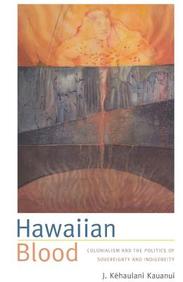 Hawaiian Blood: Colonialism And The Politics Of Sovereignty And Indigeneity (Narrating Native Histories)₹2147This item
 Maarikaadu₹63
 Natyamayuri₹63
Total for 3 items₹2273₹2634You save ₹361
Product Specifications
Book Summary
In the Hawaiian Homes Commission Act (HHCA) of 1921, the U.S. Congress defined
"native Hawaiians" as those people "with at least one-half blood quantum of
individuals inhabiting the Hawaiian Islands prior to 1778." This "blood logic"
has since become an entrenched part of the legal system in Hawai'i. "Hawaiian
Blood" is the first comprehensive history and analysis of this federal law that
equates Hawaiian cultural identity with a quantifiable amount of blood. J.
Kēhaulani Kauanui explains how blood quantum classification emerged as a way to
undermine Native Hawaiian (Kanaka Maoli) sovereignty. Within the framework of
the 50-percent rule, intermarriage "dilutes" the number of state-recognized
Native Hawaiians. Thus, rather
Book Specifications
- ISBN-13
- 9780822340799
- Language
- English
- Binding
- Paper Back
- Publisher
- Duke University Press Books
- Publishing Date
- 2008-11-01
- Total Pages
- 264