
₹7273
₹10164
(28% Off)
Inclusive of all taxes
Qty
Buying in bulk?

In Stock

Guaranteed Service

Free Home Delivery
above ₹199
Check Delivery
Enter pincode for exact delivery dates / charges and to know if express delivery is available
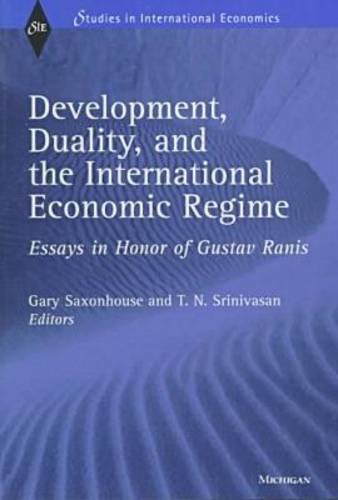
Development, Duality, and the International Economic Regime: Essays In Honor of Gustav Ranis (Studies in International Economics)
by Gary Saxonhouse, T. N. Srinivasan (Author),
University of Michigan Press (Publisher)
Product Specifications
Book Description
When Gustav Ranis began his scholarly career in the field of economic
development, the global economy presented a landscape of widely contrasting
conditions for its participants. Almost two-thirds of the global population was
ill-fed, ill-housed, illiterate, and lacking access to proper medical care.
Today, four decades later, while standards of living have generally improved,
and some areas of Asia, Latin America, and the Middle East have become highly
productive economies, the gap between the wealthy few and the rest of the world
has widened. Very significant areas of the globe remain desperately poor.
In a much-needed effort to assess the current issues facing developing countries
and development economics,
Book Specifications
ISBN-13 9780472109821
Language English
Binding Hard Bound
Publisher University of Michigan Press
Publishing Date 1999-03-01
Total Pages 504